What Is Atziri's Temple in PoE2? Beginner Guide to the Console, Rooms, and Rewards
A clear first-read guide for players who have seen Atziri's Temple, the Temple Console, or a planner link and want to understand what the mechanic is actually asking them to do before they start moving rooms.
About the editorial team
PoE2 Temple Planner Editorial Team
Editorial team
The PoE2 Temple Planner editorial team prepares practical Temple guides using the linked official patch notes, game-data references, and clearly identified community sources.
Editorial standard
Editorial note: This guide summarizes the sources linked on this page. Strategy recommendations are editorial guidance and may change with game updates.
On this page
Opportunity and intent
GSC showed a low-CTR opportunity for poe 2 atziri's temple, while Similarweb validated related low-difficulty informational variants. The page is written as a beginner explanation, not another planner landing page, so it does not compete with the homepage or the full room database guide.
Quick answer: Atziri's Temple is a buildable endgame dungeon
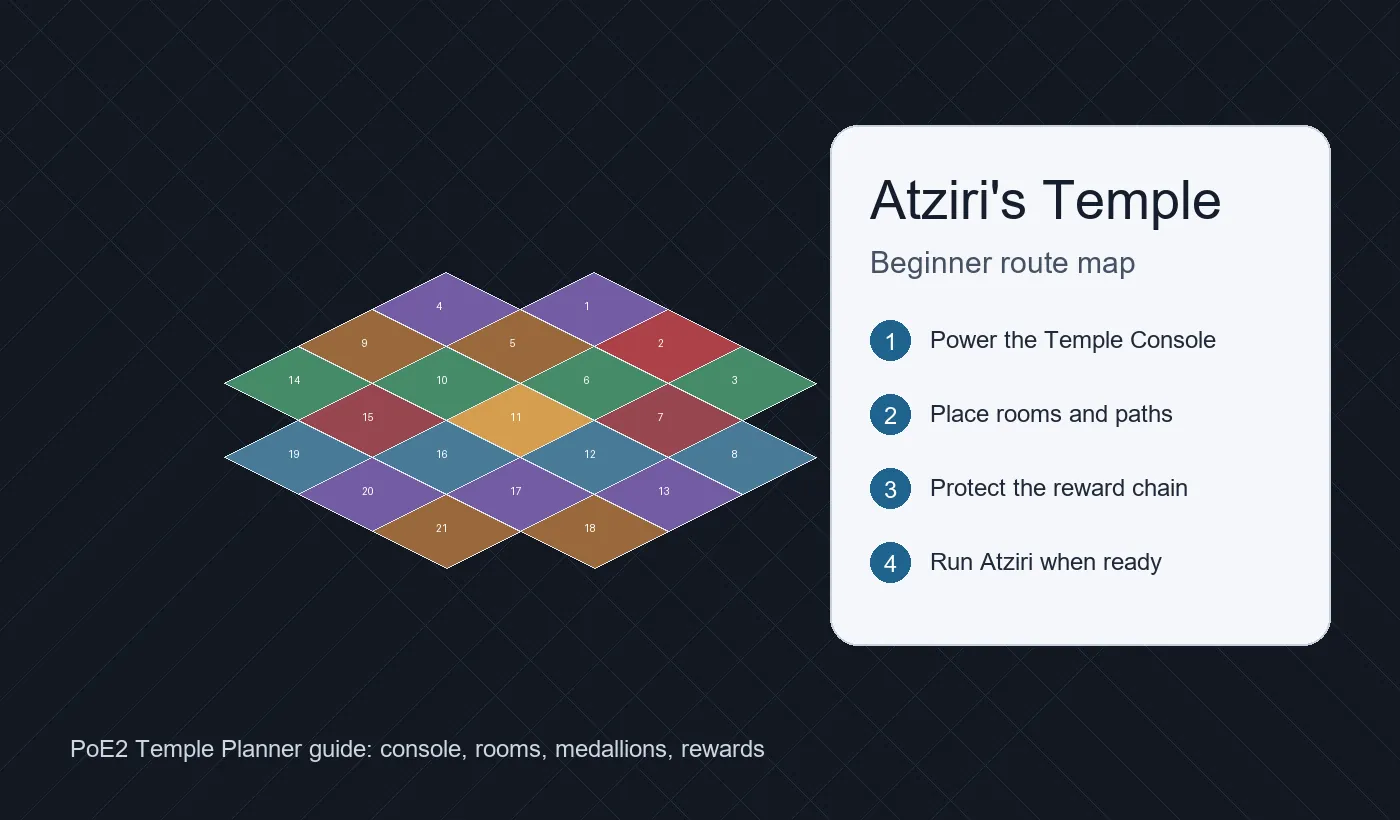
Atziri's Temple is best understood as a dungeon you shape before you run it. You use Temple choices to create paths, improve rooms, and decide what kind of reward chain the final temple should support.
| Question | Short answer | What to do next |
|---|---|---|
| What is it? | A customizable Temple run built from rooms, paths, and reward modifiers. | Learn the Console, then plan one clear route. |
| Why does it matter? | The rooms you improve decide whether the final run favors loot, XP, corruption value, or bossing. | Choose one reward goal before upgrading. |
| What is the Console? | The planning interface that lets you inspect and shape the Temple state. | Check paths before chasing Tier 3 rooms. |
| Where does the planner fit? | A planner helps you test reachability, room support, and Generator coverage before committing. | Use the planner after you understand the mechanic. |
| What should beginners avoid? | Mixing every attractive room into one disconnected layout. | Protect one coherent chain first. |
How Atziri's Temple works in plain language
Think of the Temple as a set of decisions that become a final dungeon. Each decision changes the layout in a small way: a room may become more valuable, a connection may open, or a support room may make nearby rooms stronger. The final Temple is the result of those decisions rather than a fixed map you simply enter.
The important point is that room text is only half of the mechanic. A powerful room that is unreachable, unsupported, or pointed at the wrong reward goal can feel worse than a modest room on the main route. That is why beginner success usually comes from three habits: keep the route readable, keep the reward goal narrow, and use the planner to test the layout before the final run.
Beginner rule
Do not ask whether every room is good in isolation. Ask whether this room helps the same Temple plan as the rooms around it.
What the Temple Console is for
The Temple Console is the place where the current Temple state becomes visible. It helps you see the room layout, the paths between rooms, and the choices that can change the future Temple. For a new player, the Console can look like a puzzle board, but the practical question is simple: which route will still matter when the Temple is complete?
Use the Console to identify the entrance path, the rooms that already support value, and the rooms that are tempting but disconnected. If you can explain the route in one sentence, you are probably ready to make the next choice. If you need five explanations, the plan is probably too fragile.
- Mark the route from the entrance before picking upgrades.
- Check whether a reward room is actually reachable.
- Avoid moving toward a room only because its name looks valuable.
- Keep support rooms close enough to affect the rooms you care about.
Rooms, paths, and tiers: the three pieces beginners confuse
Rooms define the kind of value the Temple can produce. Paths decide whether you can reach that value. Tiers decide how strongly a room performs. New players often focus on tiers first, but pathing usually determines whether the tier matters at all.
| Piece | What it controls | Beginner mistake | Better habit |
|---|---|---|---|
| Room type | Loot, XP, corruption, boss, or support identity | Picking every exciting room | Pick rooms that support one goal |
| Path | Whether the final Temple can be cleared efficiently | Leaving value rooms isolated | Secure the main route early |
| Tier | How strong a room effect becomes | Forcing Tier 3 at any cost | Upgrade the rooms already on the route |
| Support room | Whether nearby rooms scale or unlock | Adding support too late | Place support before the layout scatters |
What rewards should you plan around?
Most Temple reward plans fall into a few broad families. Currency and item value usually want consistent loot rooms and broad scaling. XP plans care about density, clear comfort, and whether your build can actually handle the extra pressure. Corruption and boss plans can be strong, but they become risky when the support chain is incomplete.
| Goal | Typical support | When it feels bad |
|---|---|---|
| Currency or general loot | Smithy, Alchemy Lab, Spymaster, Thaumaturge | The room chain is split across the map |
| Experience | Synthflesh Lab, Garrison, Generator, Workshop | Density rises faster than your clear speed |
| Corruption value | Corruption Chamber, Sacrificial Chamber, Thaumaturge | You force it without the support route |
| Balanced beginner run | One value room, one support room, safe pathing | You keep pivoting after every new offer |
When to use a PoE2 Atziri's Temple planner
A planner is most useful after you understand the basic mechanic but before you commit to the final route. It should answer practical questions: can I reach the reward rooms, does this support room cover enough of the board, and does the layout still make sense if one desired room never appears?
Open the PoE2 Temple Planner
Test a route, Generator coverage, and a room chain before running the final Temple.
Read the full Temple guide
Use the larger guide when you need room names, upgrade rules, and detailed strategy examples.
Check room connections
Use the cheat sheet when you need a compact reminder of which rooms support each other.
Planner-first, not planner-only
The planner should make your decision easier. If it becomes a way to justify a scattered layout, simplify the Temple goal first.
Common beginner mistakes with Atziri's Temple
- Treating the Temple like a fixed map instead of a buildable run.
- Chasing Tier 3 before confirming the room is reachable.
- Mixing loot, XP, corruption, and boss goals into one layout.
- Ignoring support range until the valuable rooms are already scattered.
- Copying a showcase layout without checking whether the current Temple state can support it.
- Entering the final Temple without a simple route through the rooms that matter.
What to do after your first few Temples
After a few runs, stop asking only whether the Temple was profitable. Ask why it felt good or bad. Did the route stay short? Did the support rooms matter? Did your reward goal remain consistent after the early choices? These questions turn the Temple from a confusing board into a repeatable planning loop.
When the basics feel natural, move from this article to the planner and the full guide. The planner helps you test the layout visually, while the guide explains individual room rules and deeper upgrade chains. That combination is stronger than memorizing one perfect layout.
Frequently asked questions
Sources and further reading
These references and internal resources support the beginner explanation without replacing current in-game testing.
- Official Path of Exile 2 news and patch notes - Primary source for game update context and current mechanic changes.
- PoE2DB Temple of Atziri reference - Room-name and mechanic reference for Temple terminology.
- PoE2 Temple Planner guide - Internal reference for room effects, upgrade chains, and planning strategy.
- PoE2 Temple room connection cheat sheet - Internal reference for quick room relationship checks.
About the editorial team
PoE2 Temple Planner Editorial Team
The PoE2 Temple Planner editorial team maintains this guide and reviews it against the sources linked on this page. Corrections can be sent to [email protected].
Understand the mechanic, then test the route
Use this beginner guide to name the Temple goal, then open the planner to test whether your rooms, paths, and support choices actually work together.