PoE2 Atziri Drops and Rewards: What Is Worth Chasing?
Atziri reward planning is not only about the boss kill. The real decision is whether your Temple route, medallions, vault rooms, and build safety make the final run worth committing.
About the editorial team
PoE2 Temple Planner Editorial Team
Editorial team
The PoE2 Temple Planner editorial team prepares practical Temple guides using the linked official patch notes, game-data references, and clearly identified community sources.
Editorial standard
Editorial note: This guide summarizes the sources linked on this page. Strategy recommendations are editorial guidance and may change with game updates.
On this page
Opportunity and search intent
GSC did not expose a safe 10-30 position new-page opportunity in the last 28 days, so this page uses Similarweb-first validation. Similarweb showed strong low-difficulty Atziri and Temple demand, while exact drop/reward variants were thin; the page therefore owns the reward-decision intent and leaves broad Atziri, planner, and boss-mechanics intent to existing pages.
Quick answer: chase Atziri rewards only when the route already supports value
Do not treat Atziri as a guaranteed jackpot. A good Atziri run starts with a reachable boss route, one reward plan, and a fallback payout if the unique drop does not appear. If the Temple has no clean path, no medallion plan, or weak reward rooms, selling the run, saving the medallion, or farming a safer layout may be better.
| Reward source | Best when | Risk to avoid |
|---|---|---|
| Atziri boss drops | Your build can clear safely and the route does not sacrifice the whole Temple | Forcing the boss while disconnected reward rooms carry the real value |
| Vault and chest rewards | The vault-style room is reachable and supported by reward modifiers | Treating every chest room as equal even when pathing is poor |
| Medallion value | The saved medallion unlocks a stronger future Temple or boss route | Spending medallions just because they are available |
| Incursion currency | You can convert the run into liquid value even without a rare drop | Ignoring market value and overvaluing a single item outcome |
| XP or density rewards | The layout has enough density and the build can handle pressure | Mixing XP, boss, and currency goals into one fragile route |
What can Atziri actually reward in PoE2?
Atziri rewards are easiest to understand as a bundle, not a single loot table. The boss can be the headline, but the Temple around the boss decides whether the run has backup value. Chests, vault-style rooms, medallions, room upgrades, and Incursion currency all matter because most players will not see a rare chase outcome every run.
The safest planning question is therefore simple: if the boss drop is ordinary, does the Temple still pay for the time and risk? If the answer is yes, the Atziri route is worth protecting. If the answer is no, you are gambling on one outcome and should only do it when the build is comfortable and the entry cost is low.
Planning rule
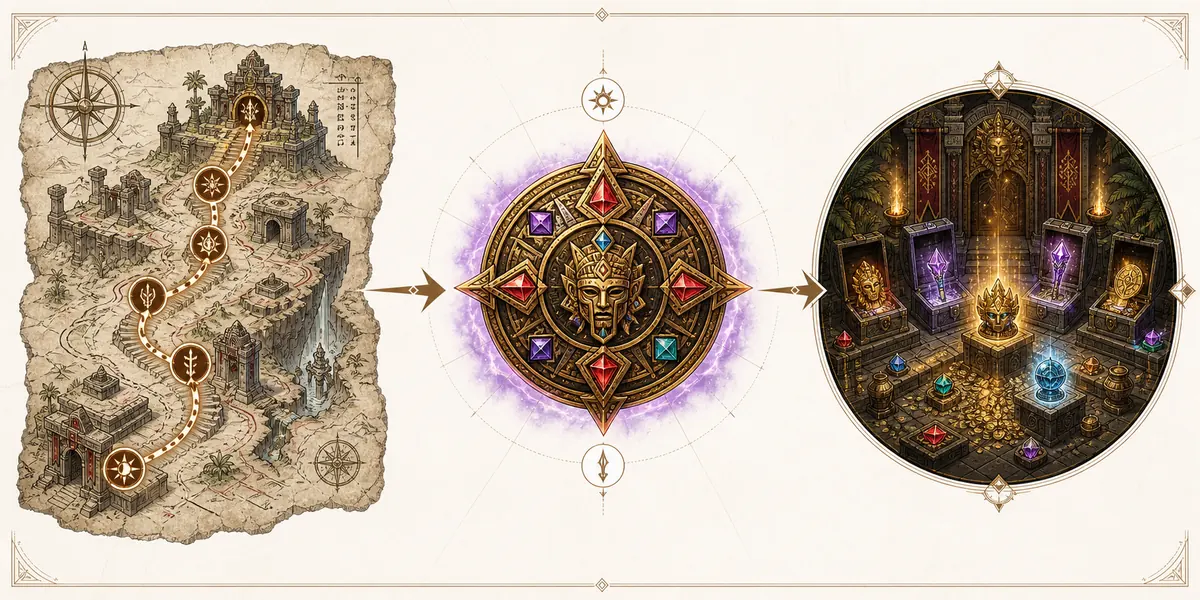
Value the whole Temple first, then treat the Atziri drop as upside. That keeps one unlucky boss kill from ruining the run.
Atziri drop value matrix
Search demand around PoE2 Atziri is broad, but the player problem is specific: should you protect a boss route, a vault route, or a safer reward chain? Use a value matrix instead of a flat tier list because the correct choice changes with build strength, medallion supply, and market prices.
| Situation | Best reward target | Why it works |
|---|---|---|
| Strong boss build, clean path | Atziri boss plus one backup reward room | You can take the high-value attempt without losing all fallback value. |
| Medium build, high-value vault room | Vault/chest route first, boss only if path remains efficient | The guaranteed room value protects the run from a weak boss drop. |
| Rare medallion or expensive entry | Save or sell unless the Temple has two value sources | Entry cost matters more when the layout has only one payoff. |
| XP-focused layout | Density and support rooms | Boss rewards should not pull the run away from the XP goal. |
| Patch uncertainty or new economy | Liquid currency and flexible rooms | When prices move, flexible payout beats a narrow chase item. |
How medallions and vault rooms change the reward decision
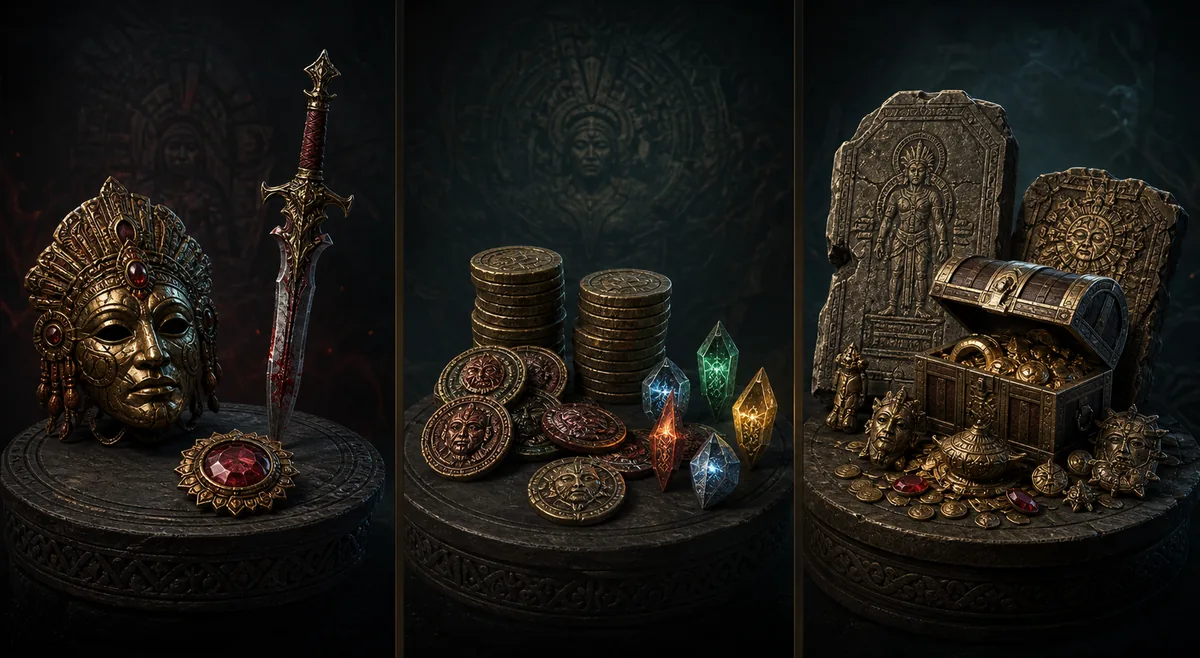
Medallions make Atziri planning more strategic because they can represent either today’s run or a better future run. If the current Temple already has a boss route, a reachable reward room, and enough support, spending a medallion can make sense. If the layout is scattered, the medallion may be more valuable as a saved planning piece.
Vault rooms and direct reward rooms are similar: they are only as valuable as their accessibility. A disconnected vault can look impressive but still waste the run. A modest connected reward room can be better because it gives value without forcing the player to break the route.
- Check the route from entrance to boss or vault before valuing the reward.
- Ask whether the Temple has a second payout if Atziri drops nothing special.
- Spend medallions on layouts with clean pathing, not on layouts that only look exciting.
- Use the planner to test whether reward rooms and support rooms actually connect.
When Atziri is worth running, saving, or skipping
Run Atziri when your build clears the encounter comfortably and the Temple has at least one backup value source. Save the route or medallion when the current Temple is promising but incomplete. Skip or reroute when the boss path makes you abandon the rooms that would have paid the run.
| Decision | Use it when | Next step |
|---|---|---|
| Run now | Boss path is clean, build is ready, and reward rooms are reachable | Open the planner, confirm support, then commit. |
| Save for later | Medallion value is high but the current layout lacks support | Protect the medallion and build a cleaner Temple. |
| Prioritize vault | Vault/chest reward is strong and boss route is inefficient | Take the reliable payout first. |
| Skip boss | Build is unsafe or route sacrifices all value | Farm a safer Temple or sell the opportunity. |
A practical reward workflow before committing the Temple
Use this workflow when a Temple looks tempting but you are unsure whether Atziri rewards justify the path. It keeps the decision tied to route proof instead of hype around one possible drop.
- Name the main payout: boss, vault, currency, XP, or recovery.
- Confirm the path and support rooms in the planner.
- Check whether the run still has value if the boss drop is ordinary.
- Compare medallion opportunity cost against the current layout.
- Commit only if the reward target and route tell the same story.
Open the Temple planner
Test whether the boss and reward rooms are reachable before spending a medallion.
Read the Atziri preparation guide
Use this before deciding whether your build is ready for the boss route.
Check Atziri boss mechanics
Review the fight pattern when the reward plan depends on a clean kill.
Compare Temple reward rooms
Use the broader reward guide when vaults or support rooms may be better than the boss route.
Frequently asked questions
Sources and further reading
These sources support the patch and terminology context used in this reward-decision guide.
- Path of Exile 2 Content Update 0.5.0 patch notes - Official source for Temple reward, medallion, and room-rule changes.
- PoE2DB Atziri Temple reference - Reference for current Temple terminology and reward context.
- PoE2DB Temple of Atziri reference - Additional terminology reference for Atziri Temple content.
- Atziri boss mechanics guide - Internal guide for fight mechanics and safety checks.
About the editorial team
PoE2 Temple Planner Editorial Team
The PoE2 Temple Planner editorial team maintains this guide and reviews it against the sources linked on this page. Corrections can be sent to [email protected].
Check reward value before you commit the route
Use the planner to test pathing, then compare boss, vault, and medallion value before entering the final Temple.