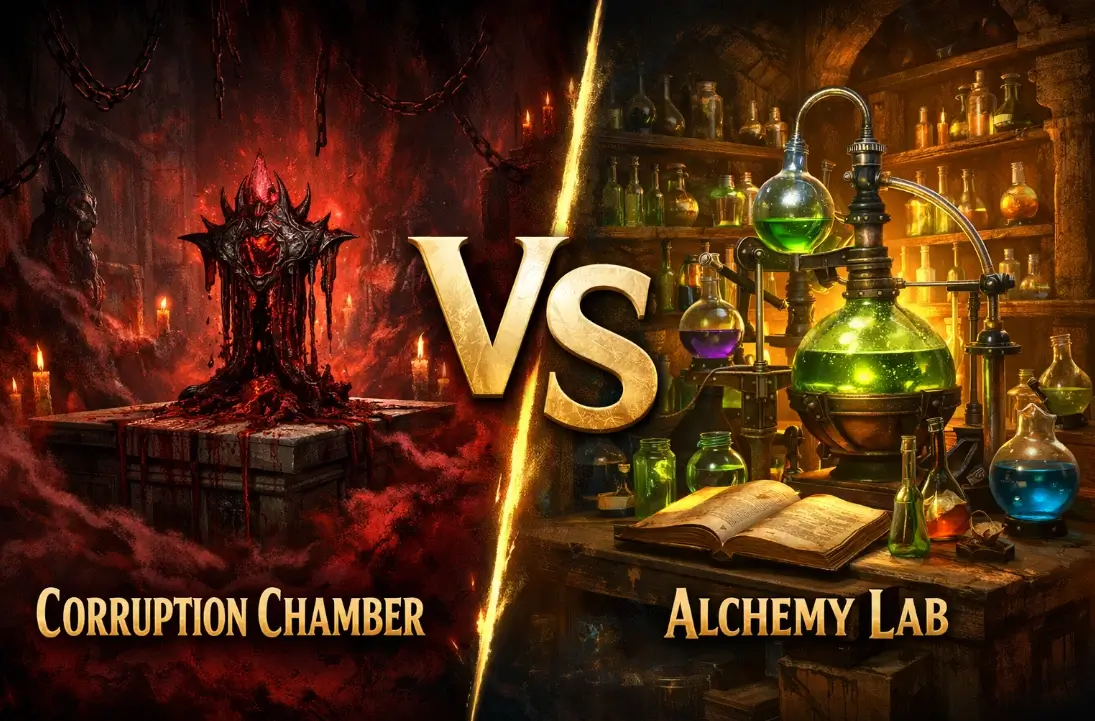
Corruption Chamber vs Alchemy Lab in PoE2: Which Temple Room Should You Prioritize?
A practical comparison for players deciding between stable broad loot value and a more specialized corruption-focused room chain inside the Temple of Atziri.
About the editorial team
PoE2 Temple Planner Editorial Team
Editorial team
The PoE2 Temple Planner editorial team prepares practical Temple guides using the linked official patch notes, game-data references, and clearly identified community sources.
Editorial standard
Editorial note: This guide summarizes the sources linked on this page. Strategy recommendations are editorial guidance and may change with game updates.
On this page
How this comparison was built
I compared these two rooms using the current official Temple patch context, current PoE2DB room text, and a practical strategy question: if a player only gets one meaningful line of investment, which room gives the cleaner payoff for the temple they are actually building, not just the perfect one they imagined?
Quick comparison: Corruption Chamber or Alchemy Lab?
If you want the short answer, Alchemy Lab is usually the safer broad-farming choice, while Corruption Chamber is the sharper specialist choice when you can support its chain and care about high-roll corruption or juiced rare-monster outcomes.
| Topic | Corruption Chamber | Alchemy Lab |
|---|---|---|
| Core identity | Specialized room with extra-mod rare monsters and corruption utility | Broad loot-quality room with item-rarity scaling and a steadier farm identity |
| Best for | High-roll upside, corruption utility, rare-focused temple plans | General farming, consistent loot quality, smoother progression |
| Tier 1 and Tier 2 feel | Usable, but often less immediately legible than broad rarity | Easy to feel and easy to justify even before the temple is perfect |
| Tier 3 payoff | Big identity spike: stronger rare-monster pressure plus corruption device | Big efficiency spike: 60% rarity, 50% gold, and Soul Core device |
| Main support chain | Thaumaturge and Sacrificial Chamber | Thaumaturge for upgrades, Golem Works for effect scaling |
| Default recommendation | Take first when your temple already leans into the corruption chain | Take first when you want the cleanest general-purpose value |
What each room actually does right now
Corruption Chamber and Alchemy Lab are easy to compare badly because both are loot-adjacent rooms. In practice, they solve different problems. Corruption Chamber is a narrower room with a more dramatic identity. It pushes rare monsters toward stronger modifier states, and at Tier 3 it gains a more distinctive corruption-device payoff. Alchemy Lab is simpler and broader. It improves item-rarity outcomes across monster drops, then becomes even more generally useful at Tier 3 by adding a gold bonus and a Soul Core device.
That difference matters because players searching this question are usually making a priority choice, not a trivia comparison. They want to know which room is more worth the slot, the pathing effort, and the upgrade pressure in the temple they are building tonight.
| Room | Tier 1 | Tier 2 | Tier 3 |
|---|---|---|---|
| Corruption Chamber | 15% chance for Rare Monsters to have an additional Modifier | 30% chance for Rare Monsters to have an additional Modifier | 60% chance for Rare Monsters to have an additional Modifier, an extra Corrupted Abomination, and a corruption device |
| Alchemy Lab | 15% increased Rarity of Items Dropped by Monsters | 30% increased Rarity of Items Dropped by Monsters | 60% increased Rarity of Items Dropped by Monsters, 50% increased Gold found, and a Soul Core device |
A useful shortcut
If you cannot explain your temple goal in one sentence, Alchemy Lab is usually the safer default. Corruption Chamber becomes stronger when you know exactly why you want it.
Tier value: which room feels better before and after Tier 3
Before Tier 3, Alchemy Lab is usually easier to defend. Broad item-rarity scaling is straightforward, and the room does not need much imagination to feel useful. If your temple is merely decent rather than immaculate, Alchemy Lab still reads as a good room. Corruption Chamber is different. Its lower-tier versions are real, but they tend to feel more contextual because their payoff depends on how much you value more dangerous, more juiced rare monsters and how much you care about eventually reaching the stronger corruption identity.
At Tier 3, the comparison tightens. Corruption Chamber gets a clearer identity spike because it adds both stronger rare-monster pressure and a more recognizable device payoff. Alchemy Lab also becomes more attractive at Tier 3, though, because it stops being only a generic rarity room. It now adds gold and a Soul Core device on top of its broader loot role. That makes the room harder to dismiss as merely the safe option.
- If your room may stay at Tier 1 or Tier 2, Alchemy Lab is usually the cleaner recommendation.
- If you have a believable route to Tier 3 and want a more specialized payoff, Corruption Chamber becomes more attractive.
- If your temple is already rich in rare-monster scaling and corruption utility, Corruption Chamber rises faster than it would in a generic layout.
- If your temple is broad, flexible, or still messy, Alchemy Lab keeps more of its value.
Upgrade paths and support chains matter more than people think
The biggest mistake in this comparison is looking only at the final room text. These rooms belong to different support ecosystems. Corruption Chamber upgrades through Thaumaturge or Sacrificial Chamber and is further amplified by the same Temple logic family. Alchemy Lab upgrades through Thaumaturge, but its effect scaling sits in the Golem Works chain. So the practical question is not just what does the room do, but what chain are you already positioned to support?
This is where real temple planning begins to separate itself from generic guide writing. If your layout already includes or strongly wants Golem Works, Alchemy Lab becomes easier to justify because it fits a broader multi-room value plan. If your layout is already leaning toward Thaumaturge, Sacrificial Chamber, or corruption utility, Corruption Chamber becomes the more coherent choice even if its baseline text looks narrower at first glance.
| Question | Corruption Chamber | Alchemy Lab |
|---|---|---|
| Who upgrades it? | Thaumaturge or Sacrificial Chamber | Thaumaturge x2 |
| Which support room increases its modifier effect? | Thaumaturge | Golem Works |
| What style of temple does it fit naturally? | Specialist corruption or rare-monster plan | General loot, scaling, or flexible farming plan |
| How forgiving is the chain? | More deliberate and easier to overbuild badly | Usually easier to fit into a broadly healthy temple |
If you only remember one thing from this article, make it this: the better room is often the room that matches the chain you can actually complete.
When Alchemy Lab is the better first pick
Alchemy Lab is the better first pick in most general-purpose situations. It is broad, understandable, and less dependent on a high-drama temple shape. If your goal is simply to make the run feel richer overall, Alchemy Lab does that with very little editorial explanation. It improves the quality of monster drops across the run rather than asking you to care about one specialized corruption moment.
Take Alchemy Lab first when
- You want a general farming room rather than a specialist utility room.
- Your temple may never become a perfect Tier 3 masterpiece.
- You are already leaning toward Golem Works or other broad-support chains.
- You care about stable value more than high-variance corruption upside.
- You want a room that still feels good in balanced or beginner-friendly layouts.
In practical terms, Alchemy Lab is often the answer for players who want low regret. It is not just that the room is good. It is that the room remains good when the temple is merely solid instead of brilliant.
When Corruption Chamber is the better first pick
Corruption Chamber becomes the better first pick when your temple is already moving in that direction or when your actual goal is meaningfully different from broad farming. If you care about corruption utility, if you are intentionally investing in the Thaumaturge and Sacrificial Chamber side of the Temple, or if you want a room whose identity sharpens dramatically at Tier 3, Corruption Chamber has a stronger argument.
Take Corruption Chamber first when
- You already have a believable path into the Thaumaturge or Sacrifice chain.
- You are specifically chasing corruption utility rather than broad generic loot quality.
- Your temple can plausibly reach a meaningful Tier 3 corruption payoff.
- You want stronger rare-monster pressure as part of the room's identity.
- You are comfortable choosing a narrower room because your goal is narrower.
Corruption Chamber is not the room you choose because you are unsure. It is the room you choose because you know what kind of temple you are trying to build.
This does not make Corruption Chamber automatically more advanced or more profitable in every case. It makes it more specific. Specific rooms can be excellent, but only when the surrounding temple tells the same story.
How to decide in your current temple
If you are standing in front of a real temple decision and do not want theory, use this short framework. First, ask whether your run is trying to be broad or specific. Broad means general loot quality, flexible rewards, and a low-regret room. Specific means corruption utility, a sharper T3 identity, and a narrower chain. Second, ask whether your current pathing already favors Golem Works support or Thaumaturge and Sacrifice support. Third, ask whether the room is likely to stay at Tier 1 or Tier 2. If so, lean toward Alchemy Lab unless you have a very specific corruption reason.
Do not confuse the room decision with an item-corruption tutorial. Searches such as “how to double corrupt in PoE2” have a separate intent: this comparison helps you decide whether to invest in the Corruption Chamber chain, while the item you risk and the exact outcome rules still need their own current-game check.
| Your current situation | Better choice |
|---|---|
| I want the safest all-round value | Alchemy Lab |
| My temple is already leaning into Golem Works support | Alchemy Lab |
| My temple is already leaning into Thaumaturge or Sacrifice support | Corruption Chamber |
| I am unlikely to reach Tier 3 | Alchemy Lab |
| I care about corruption utility and a stronger specialist payoff | Corruption Chamber |
| I want a room that works even in a balanced, imperfect temple | Alchemy Lab |
Open the planner
Map the room chain you can actually reach before you commit to a specialist payoff.
Read the full temple guide
Review room upgrades, support chains, and general Temple planning if you want the broader context.
Patch context that changes older advice
Older room advice can be misleading here. In the 0.4.0c patch cycle, Temple room modifiers were substantially buffed, Tier 3 Corruption Chamber gained an extra Corrupted Abomination, and Tier 3 Alchemy Lab gained a 50% gold bonus. That matters because it means both rooms are better than many early write-ups imply.
Later patch notes also improved Temple UI clarity by showing possible upgrades and current Temple modifiers more clearly. So the modern comparison is less about guessing invisible systems and more about reading whether your current layout can support the room chain you want. Community anecdotes are still useful for texture, but official patch notes should outrank remembered launch-era advice whenever the two disagree.
Trust note
If a guide ignores the 0.4.0c room buffs or the current Temple UI changes, treat its room ranking with caution.
Common mistakes when choosing between these rooms
- Comparing the rooms only by their Tier 3 fantasy instead of by the temple you can realistically finish.
- Choosing Corruption Chamber because it sounds exciting even when the room chain is weak or incomplete.
- Calling Alchemy Lab boring and then quietly benefiting from its broader consistency every run.
- Ignoring support ecosystems such as Golem Works, Thaumaturge, and Sacrificial Chamber.
- Assuming older room values still apply after the 0.4.0c buff pass.
- Treating a specialist room as a universal room.
The fix is usually simple. Stop asking which room looks cooler in isolation and ask which room your current temple can support cleanly. That one question solves most of the false dilemmas in Temple planning.
Frequently asked questions
Sources and further reading
To keep this comparison aligned with current Temple behavior, I used official Path of Exile 2 patch notes and current PoE2DB room data, plus one community thread for pathing context.
- Path of Exile 2 content update 0.4.0 - Official source for the Fate of the Vaal league and baseline Temple system context.
- Path of Exile 2 patch notes 0.4.0c - Official source for the Temple room modifier buffs and the specific Tier 3 changes to Corruption Chamber and Alchemy Lab.
- Path of Exile 2 hotfix 0.4.0c Hotfix 5 - Official source for higher-rarity monster scaling in endgame Temples.
- Path of Exile 2 patch notes 0.4.0d - Official source for Temple UI improvements and clearer room evaluation feedback.
- PoE2DB: Temple of Atziri - Reference for the current room effects, room names, and upgrade chains.
- Official forum discussion on Temple pathing - Supplementary community context used for pathing discussion rather than as the primary authority.
About the editorial team
PoE2 Temple Planner Editorial Team
The PoE2 Temple Planner editorial team maintains this guide and reviews it against the sources linked on this page. Corrections can be sent to [email protected].
Test the room choice before your next Temple
If you want to compare support chains, sketch a corruption-first route, or see whether a broader Alchemy plan fits your layout better, use the planner first and then cross-check your room priorities with the main guide.