Temple of Chaos PoE2 Guide: Location, Rounds, Modifiers & Rewards
Temple of Chaos is the challenge location for Trial of Chaos, not Atziri's Temple. Use an Inscribed Ultimatum, choose modifiers that your build can actually survive, and leave with valuable rewards before greed turns a good run into a loss.
About the editorial team
PoE2 Temple Planner Editorial Team
Editorial team
The PoE2 Temple Planner editorial team prepares practical Path of Exile 2 guides from official patch notes, game-data references, and clearly identified community sources.
Editorial standard
Editorial note: Trial rules, rewards, and balance can change with game updates. Check the current in-game text before risking an expensive Inscribed Ultimatum.
On this page
Search intent and scope
This guide targets Temple of Chaos PoE2 and Trial of Chaos questions: where the challenge starts, how its rounds work, how to judge modifiers, and when the reward is worth the risk. It does not replace the separate Atziri's Temple planner, room map, or reward-room guides. Game terms and reward behavior should be rechecked after major patches.
Temple of Chaos PoE2: the short answer
If you searched for Temple of Chaos because you want to run Trial of Chaos, start with the token and the build check below. The most important decision is not the first room; it is whether the next modifier still leaves you a reliable way to finish or exit with value.
| Question | Short answer | Best next step |
|---|---|---|
| Where is Temple of Chaos? | It is the challenge location used for Trial of Chaos, accessed with an Inscribed Ultimatum. | Inspect the token and open the current Trial entry rather than searching the Atziri Temple planner. |
| How many rounds are there? | Common current guides describe 4, 7, or 10 rounds based on the area-level bracket of the Inscribed Ultimatum. | Treat the in-game token text as the final authority before you enter. |
| Should every run reach ten rounds? | No. Ten rounds can offer the best progression and reward path, but a valuable reward plus a dangerous modifier can justify leaving. | Use a stop rule before the next choice appears. |
| Is it the same as Atziri's Temple? | No. Both use Temple language, but Atziri's Temple is a separate room-and-route planning mechanic. | Use the Atziri pages only when the query is about rooms, medallions, or the Atziri route. |
How to find the Temple of Chaos entry
The phrase Temple of Chaos usually points to the location and challenge sequence behind Trial of Chaos. It is easy to confuse this with Atziri's Temple because both are Vaal-themed and both can lead to valuable rewards, but they solve different problems. Trial of Chaos is a repeatable challenge run. Atziri's Temple is the room-layout system you plan with the site's builder.
The normal entry item is an Inscribed Ultimatum. Current reference guides describe these as monster drops beginning in Act 3, with higher-level areas offering more demanding versions and more rounds. Before using one, read its area-level bracket, round count, and any visible reward conditions. A token is not just a key; it tells you how much time and risk the run may require.
- Confirm that the Inscribed Ultimatum is the Trial item you intend to run.
- Check single-target damage, clear speed, physical and elemental mitigation, chaos resistance, recovery, and movement options.
- Enter only when you have a plan for the modifier pool, not just a plan for the first encounter.
- Keep a clear exit rule so a good Soul Core, corrupted item, or other valuable reward is not lost to an avoidable final failure.
Do not mix the two Temple search intents
Searches such as Temple of Chaos PoE2, Trial of Chaos location, or Trial of Chaos rewards belong on this page. Searches such as Atziri's Temple rooms, Temple layout, Medallion slots, or room connections belong on the site's Atziri Temple guides. Keeping those intents separate makes the next internal link useful instead of forcing every Temple query into one article.
Atziri's Temple basics
Use this page for the separate Atziri Temple Console, rooms, paths, and reward system.
PoE2 Temple map guide
Read this when the question is about Atziri room pathing rather than Trial of Chaos.
Open the planner
Plan an Atziri Temple layout in the browser before committing room choices.
Trial of Chaos rounds and objectives
The run is built from rounds rather than a normal map clear. The objective changes, and the modifier choices you make before each round stay relevant for the rest of the run. That makes a build with stable defenses and consistent movement more reliable than a character that only looks strong in a short burst.
| Area-level bracket | Rounds | What it means |
|---|---|---|
| 39–59 | 4 | Shorter entry for learning the objective cycle and testing whether the build handles the modifier pool. |
| 60–74 | 7 | A longer reward run with more chances to accumulate value and more chances to lose it. |
| 75+ | 10 | The full progression route, including the final boss-round reward and the option to prepare for Trialmaster. |
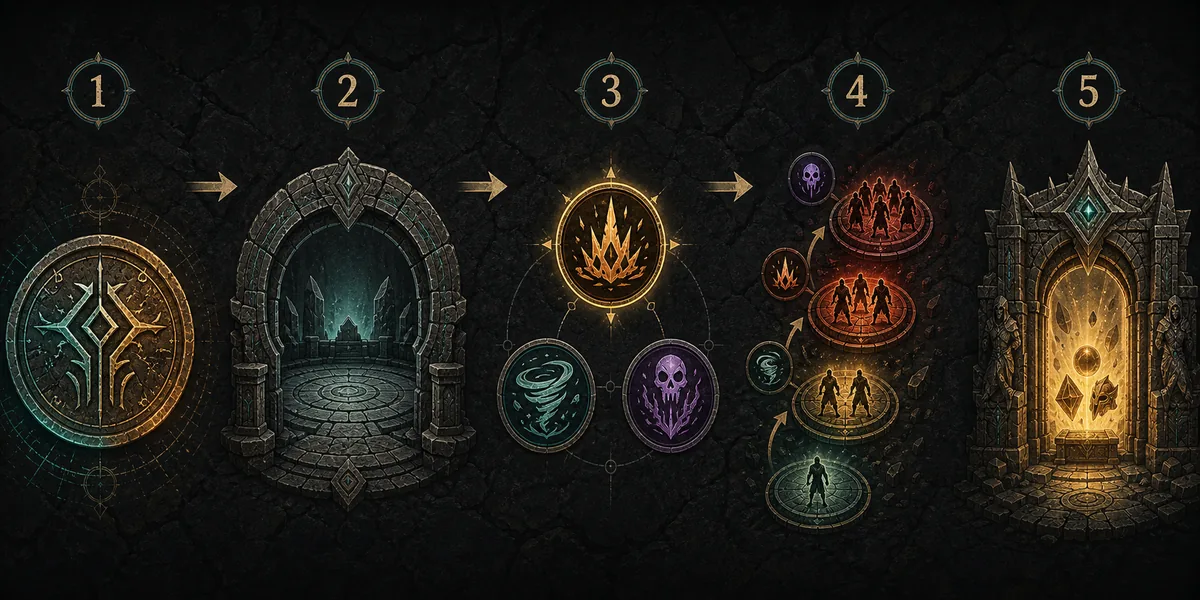
The objective sequence can include clearing monsters, surviving a timer, escorting a statue, collecting Soul Cores, sacrificing monsters, and defeating a boss. Boss rounds are commonly placed at rounds 4, 7, and 10. After a completed round, you normally decide whether to continue or leave with the rewards gathered so far.
Verify the token in game
Area-level brackets, round counts, and reward behavior can change. Use the current Inscribed Ultimatum and in-game Trial text as the final check before spending a valuable entry.
How to choose Trial of Chaos modifiers
The most common mistake is picking the modifier that sounds least inconvenient without checking what it does to the whole build. A modifier that is manageable in a clear round may become dangerous during a boss round, a timer, or an escort objective. Judge the modifier against your weakest failure mode, not your average damage on a practice pack.
| Modifier family | Consider it when | Avoid it when |
|---|---|---|
| Monster speed or stronger bosses | You have reliable defenses, movement, and enough single-target damage to shorten boss windows. | Your build already struggles to recover, kite, or survive a long boss phase. |
| Chaos, poison, or bleed pressure | Your resistance, immunity, charms, and recovery plan are already stable. | One ailment or damage type is a known gap that can end the run before you can react. |
| Petrification, Doom, or Stalking Shade hazards | You can keep moving, read the arena, and avoid stacking positional mistakes. | The build needs to stand still or has poor visual and movement control. |
| Escalating damage or Drought | Your encounters are short and your recovery does not depend on constant flask charges. | Long rounds, attrition, or flask downtime are already the way you die. |
| Resistant monsters | Your damage is physical or you have penetration and resistance reduction available. | Your main damage type is heavily reduced and you have no reliable fallback. |
Use a four-question stop rule
- What valuable reward is already secured?
- What is the next modifier likely to attack: damage, recovery, movement, or boss time?
- Can the build still complete the hardest objective in the remaining round bracket?
- If the answer is uncertain, would leaving now preserve more value than gambling the whole run?
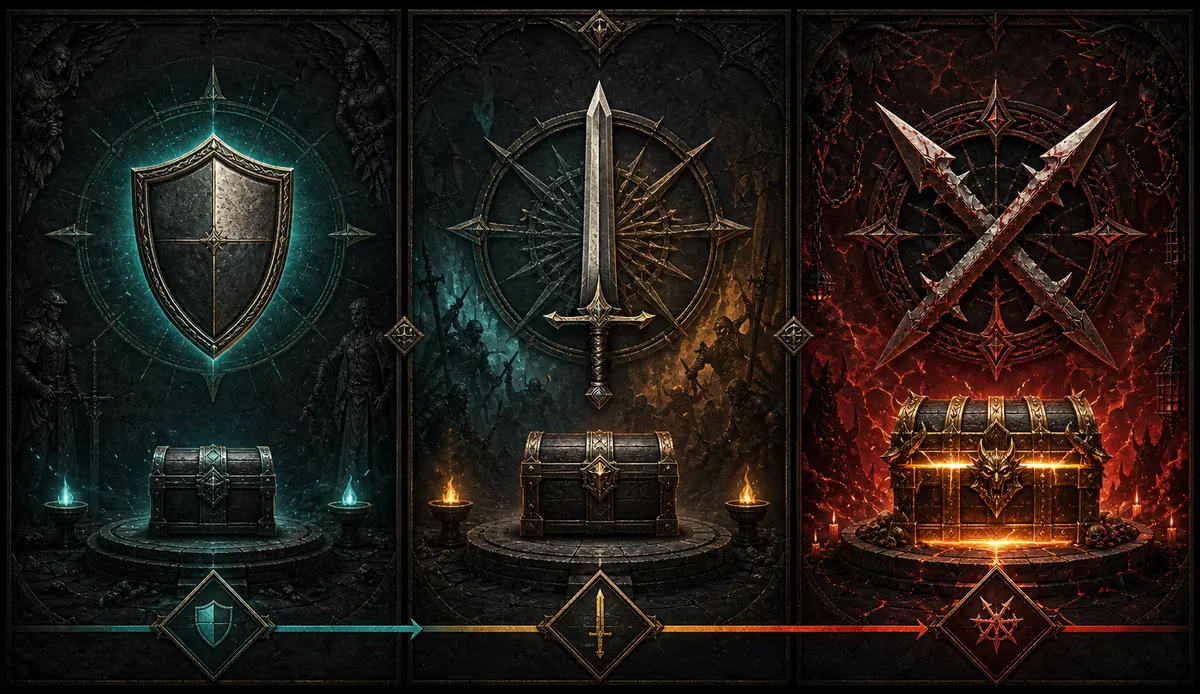
A safe exit is not a failed Trial. It is a successful risk decision when the next modifier has a clear counter and your current reward is already worth protecting. Conversely, a low-value early exit can be wasteful when the build is comfortable and the next round does not target its weak point.
Trial of Chaos rewards and when to leave
Trial of Chaos rewards are a mix of progression, repeatable loot, and the possibility of a more expensive Trialmaster route. Current reference material highlights Soul Cores as an important reward from boss rounds, while ordinary challenges can provide corrupted items. The exact value depends on the current economy, your build, and whether the next modifier creates a real chance of losing the run.
| Reward or milestone | Why it matters | Decision note |
|---|---|---|
| Soul Core from a boss round | A valuable progression or trade item that may already justify protecting the run. | Compare the next modifier with the value you would lose on failure. |
| Corrupted item from a normal challenge | A possible bonus, but not automatically worth taking every available risk. | Do not mistake a full inventory for a reason to ignore build weaknesses. |
| Final boss-round reward | The 10-round route offers the strongest progression path and can provide a Fate for the Trialmaster route. | Attempt it when the character is stable, not simply because the token allows ten rounds. |
| Three different Fates | They are used to open the Trialmaster encounter route. | Treat the Trialmaster as a separate risk decision after the Trial itself. |
The cleanest farming habit is to decide your minimum acceptable payout before the run. If the next modifier attacks a known weakness and the current reward clears that minimum, leave. If the current reward is small, the build is comfortable, and the remaining rounds are inside your plan, continue. This turns Trial of Chaos from a sequence of emotional decisions into a repeatable farming rule.
A practical reward rule
Protect a reward when the chance of losing it is more important than the expected value of the next round. Use current trade prices and the current patch, not an old tier list, to judge value.
When should you attempt Trialmaster?
After a successful full Trial of Chaos, the Trialmaster route is an optional escalation rather than an automatic next step. Current guides describe using three different Fates from the final boss round to open the Trialmaster encounter. That means a player can farm the Trial for its repeatable rewards without treating every successful ten-round run as an obligation to spend the Fates immediately.
| Your goal | Recommended decision |
|---|---|
| Consistent currency or Soul Cores | Keep the run repeatable and avoid spending expensive Fates until the character has a comfortable boss plan. |
| Unlocking the next Ascendancy milestone | Prepare a dedicated attempt with movement, recovery, positioning, and enough damage for a long fight. |
| Unique-item hunting | Accept the variance only after the cost of the Fates and the failure risk are part of the budget. |
| Learning the mechanic | Use a lower-cost practice route first and record which arena hazards or boss phases end the attempt. |
Do not use the Atziri boss guide as a substitute for Trialmaster preparation. The names and Vaal setting overlap, but the encounter, route, and failure decision are different. Keep the intent boundary clear so the page you open matches the fight you are actually about to enter.
PoE2 Atziri route guide
For Atziri Temple route planning, boss readiness, and reward fallback decisions.
PoE2 Atziri boss mechanics
For the separate Atziri fight rather than Trialmaster.
Temple rewards guide
For Atziri Temple reward-room priorities and support-room choices.
Common Temple of Chaos mistakes
- Searching for Temple of Chaos and opening an Atziri Temple layout tool without checking the intent.
- Choosing a modifier from its label alone instead of checking how it affects the next boss or objective.
- Assuming a ten-round token means the build is ready for ten rounds.
- Continuing after a valuable Soul Core even though the next modifier attacks the build's only weak defense.
- Treating a chaos statue, escort, or collection objective as a normal clear and losing time to poor positioning.
- Using an old reward list or price estimate without checking the current patch and market.
The best improvement is usually a decision rule, not a new build. Record which modifier families you can safely take, which objective types cause deaths, and the minimum reward that makes a run worth protecting. After a few attempts, the Temple of Chaos becomes easier to evaluate before the first round starts.
Temple of Chaos PoE2 FAQ
Sources and further reading
These sources support the Trial of Chaos entry, round, modifier, and reward notes used in this guide. The visual assets on this page are editorial illustrations, not official game screenshots.
- Maxroll: Trial of Chaos guide - Reference for Inscribed Ultimatums, round brackets, objectives, modifier families, Soul Cores, Fates, and Trialmaster context.
- Path of Exile 2 Content Update 0.5.0 patch notes - Official patch-note source for current Path of Exile 2 terminology and changes that may affect Temple-related mechanics.
- PoE2DB: Atziri's Temple - Reference for the separate Atziri's Temple room and layout system used in the site's other guides.
- Read the Atziri Temple basics guide - Internal follow-up when the user's search intent is Atziri's Temple rather than Trial of Chaos.
About the editorial team
PoE2 Temple Planner Editorial Team
The PoE2 Temple Planner editorial team maintains this guide and checks it against the sources linked on this page. Corrections can be sent to [email protected].
Choose the right Temple page
If you are entering Trial of Chaos, use the round and modifier rules above. If you are planning an Atziri Temple layout, open the planner and the room guides instead.