How to Reset a PoE2 Temple Layout: Vaal Temple Recovery Guide
If you are searching for a poe2 temple reset, there is no universal rewind button for an Atziri's Temple layout that has already been committed. Use this checklist to tell a real connection problem from a display issue, recover the value that is still available, and avoid wasting medallions.
About the editorial team
PoE2 Temple Planner Editorial Team
Editorial team
The PoE2 Temple Planner editorial team prepares practical Path of Exile 2 guides from official patch notes, game-data references, and clearly identified community observations.
Editorial standard
Temple rules and bug behavior can change with patches. Read the current in-game panel and official notes before spending a valuable run.
On this page
Scope and verification
This guide targets poe2 temple reset, how to reset temple poe2, and related recovery questions. It separates the planner from the live Temple, treats a committed layout as non-rewindable unless the current game explicitly says otherwise, and uses official patch notes plus game-data references for patch-sensitive checks. Community reports are observations, not permanent rules.
PoE2 Temple reset: the short answer
First identify which state you are trying to change. A planning mistake, an unconnected room, a failed run, and a genuine game bug do not have the same fix.
| Situation | Can it be reset? | Best next action |
|---|---|---|
| A layout in the website planner | Yes. It is only a plan. | Clear or edit the plan before committing anything in game. |
| Room choices already committed in the live Temple | No general rewind is documented. | Check the remaining route and salvage what still supports the goal. |
| A death, logout, or leaving the encounter | Not a layout reset. | Use the current encounter and instance rules; do not spend resources expecting the map to roll back. |
| A room, connection, or monster state that behaves incorrectly | Only a patch or server-side fix can change a bug. | Record the exact state, check official notes, and report reproducible evidence. |
What players mean by a Temple reset
Players use Temple reset to describe several different actions: clearing a saved planner layout, undoing a room choice, reopening a failed run, or fixing a room that appears disconnected. Only the first is an ordinary editing action. The planner is a safe place to test routes; it does not rewrite the live Atziri's Temple in game.
Once a live Temple has accepted room choices or progression, do not assume that closing the browser, leaving the area, dying, or opening the planner again will rewind it. If the current game version provides a special recovery rule, follow the text shown in game. Otherwise, treat the committed state as permanent for that run and make the next decision around the value that remains.
- Use the planner to compare a new route, but label it as a plan rather than a reset of the active Temple.
- Before committing the next room, verify the entrance, reachable path, room tier, and the goal the room is meant to support.
- After a choice is committed, look for a recovery route instead of a hidden undo command.
- If the state is impossible under the displayed rules, stop spending medallions and collect evidence before changing anything else.
A recovery checklist before you abandon the Temple
A bad-looking layout is often recoverable when the main route, one useful reward chain, or the Atziri path is still intact. Work from evidence and spend nothing while diagnosing. The goal is to preserve the best remaining outcome, not to force the original plan back into existence.
- Capture the current Temple state: entrance, occupied rooms, tier, remaining choices, visible modifiers, and area level.
- Confirm that you are looking at the intended Temple and not an old planner tab, a different character state, or a stale page after a reconnect.
- Trace the actual route from the entrance to the rooms that matter. A room that is valuable but unreachable is not a recovery target.
- Read the room and connection rules in the in-game panel or the room connection cheat sheet; do not infer a connection from the room names alone.
- Check whether the problem is only display or performance related. Reloading a view can refresh a display, but it does not undo committed choices.
- Choose salvage, a safe exit, or a bug report before applying another medallion or upgrade.
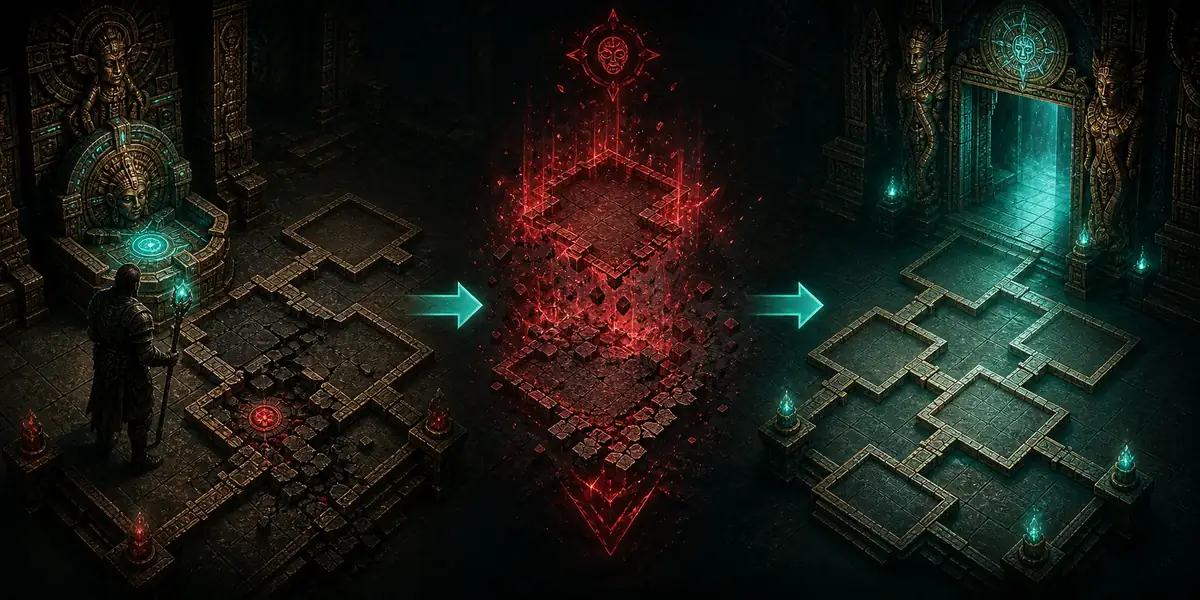
Do not pay for a reset you cannot verify
If a guide, trade listing, or community post promises a hidden reset item, compare it with the current in-game text and official patch notes first. A related Temple item may change modifiers or capacity without restoring an earlier layout.
Blocked rooms, missing connections, and bug checks
A room that cannot be reached is not automatically evidence that the Temple needs a reset. The connection may be illegal, the entrance route may be different from the route you planned, or the room may be outside the active layout. Compare the current state with the site's connection reference before spending another upgrade.
| What you see | Likely category | What to verify |
|---|---|---|
| A room has no usable path | Planning or connection problem | Entrance position, legal neighbors, and the shortest remaining route |
| The planner and game appear different | State or display mismatch | Character, Temple instance, refresh state, and a new screenshot |
| Area level or modifiers are unexpected | Mechanic interpretation | Completed Temple panel and the area-level/modifier guide |
| Monsters cannot be damaged or the encounter stalls | Possible bug or hotfix issue | Patch version, room, objective, reproducible steps, and official hotfix notes |
| A run was lost after a death or disconnect | Encounter outcome | Current instance rules and whether the live Temple itself changed |
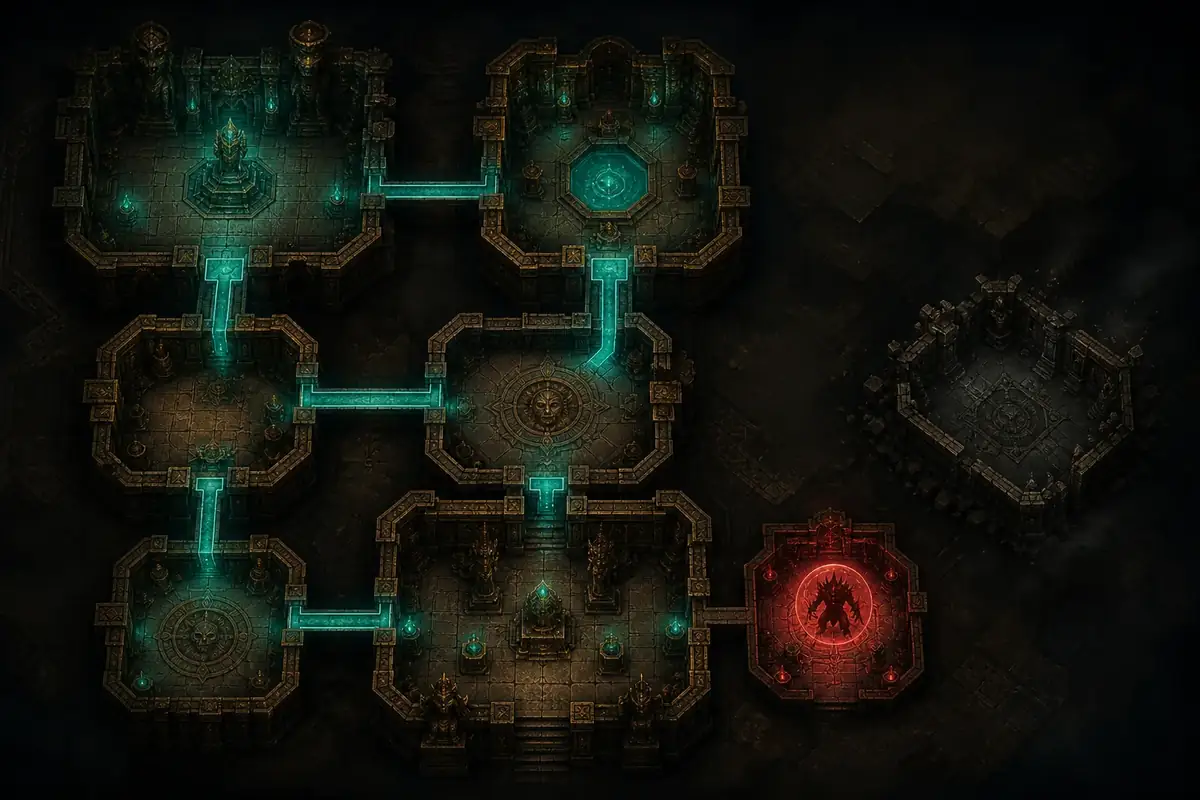
Temple room connection cheat sheet
Use this for legal room connections, upgrade chains, and Generator coverage.
Temple area level and modifiers
Use this when the apparent reset problem is actually an area-level or modifier question.
Temple map guide
Use this to re-read entrances, branches, Atziri access, and route value.
When to salvage the current layout or rebuild next run
The useful decision is usually not reset versus no reset. It is whether the current Temple still has a coherent route. Salvage when one goal remains reachable and the next choice can improve that goal. Stop investing when the route to the core reward is impossible, the remaining choices only add unrelated rooms, or the problem is reproducible and needs evidence rather than more upgrades.
| Candidate action | Use it when | SEO intent assignment |
|---|---|---|
| Create a new page | The question is whether a committed Temple can be rewound and how to recover it. | Primary intent: poe2 temple reset |
| Add a support paragraph to an existing page | The question is room connections, map reading, area level, or rewards. | Use the relevant guide; do not split a duplicate page. |
| Add an FAQ | The wording is a short yes/no question such as whether death resets the layout. | Answer on this page and keep the explanation concise. |
| Use an internal-link anchor | The visitor needs the planner or a connection/map guide after the answer. | Link with descriptive anchors such as Temple room connections or Temple planner. |
| Do not pursue | The claim depends on an unverified item, exploit, or outdated patch. | Do not publish a reset promise without current evidence. |
For the next run, start in the planner with a fresh copy, mark the entrance and non-negotiable route, then keep one farming goal visible while choices arrive. That is a true planning reset: it prevents the previous run's assumptions from turning into another sunk-cost decision.
Open the Temple planner
Start a clean route simulation without changing the live Temple.
Temple farming recovery guide
Use this when the layout is playable but the reward chain feels broken or inefficient.
Temple of Chaos guide
Use this separate page when Temple of Chaos or Trial of Chaos is the actual search intent.
When a reset question is really a bug report
If the same impossible state appears after a controlled reproduction, stop treating it as a missing reset button. A useful bug report lets developers compare the exact Temple state with the rules and patch that generated it. Official hotfix notes have addressed Temple-related encounter behavior before, so patch-specific evidence matters.
- Write the game version and the date of the run.
- Record the map or Beacon steps that produced the Temple, the area level, the room names, and the exact connection or objective that failed.
- Include screenshots or a short capture of the Temple panel, not only a summary such as 'layout is broken'.
- List the steps that reproduce the issue and whether a reload, relog, or second character changes the result.
- Check the official patch and hotfix notes, then report the issue through the current official channel.
Patch-sensitive conclusion
A reset rule can change without the page's keyword changing. Recheck the current notes and in-game wording before treating this guide as a permanent promise.
Frequently asked questions
Sources and verification
Official patch notes are the first check for patch-sensitive Temple behavior. PoE2DB is a game-data reference; community observations are useful for reproduction but are not treated as universal rules.
- Path of Exile 2 patch notes 0.5.0 - Official patch notes to check current Temple and encounter behavior.
- Path of Exile 2 patch notes 0.4.0d - Official notes for Temple UI and mechanic context.
- Path of Exile 2 Temple hotfix discussion - Official forum hotfix reference for a Temple-related encounter issue.
- PoE2DB — Atziri's Temple - Game-data reference for Temple entities and room terminology.
Editorial approach
PoE2 Temple Planner Editorial Team
This page avoids promising an exploit or a permanent reset rule. It separates documented mechanics, practical recovery steps, and bug-report evidence, then links to the planner and narrower Temple guides.
Start the next Temple with a clean plan
If the current run cannot be rewound, preserve its remaining value and use the planner to build a clearer route for the next Temple.